
When we install public art in a facility, we intend for the artwork to stay in place for many years, maybe even long after we are gone. But what happens to public art that is part of the infrastructure of a facility or place that is about to undergo renovation or be demolished? Does it get removed in pieces and reassembled like a puzzle? Does the wall get cut around it to try to salvage the artwork on it? What if it’s a painted mural?
Happily, this situation hasn’t come up very often. In cases like this, we always look for ways of preserving the artwork if it is reasonable and appropriate to do so it can be reinstalled or moved to another area. There are certain steps in our master plan to follow such as working with the artist develop a plan for the artwork; these steps are our first option. But sometimes it’s just not possible. Sometimes, we do one of the hardest things there is to do. We let it go.
We are faced with such a situation now. The Thomas Branigan Memorial Branigan Library is about to undergo much-needed renovation. It has two art installations on its ground floor that have been there for a long while. You would never guess that the teens who made the handcrafted tiles on one of the pieces are probably in their early 40’s now. The other has been a fixture for so long that most don’t even notice it.
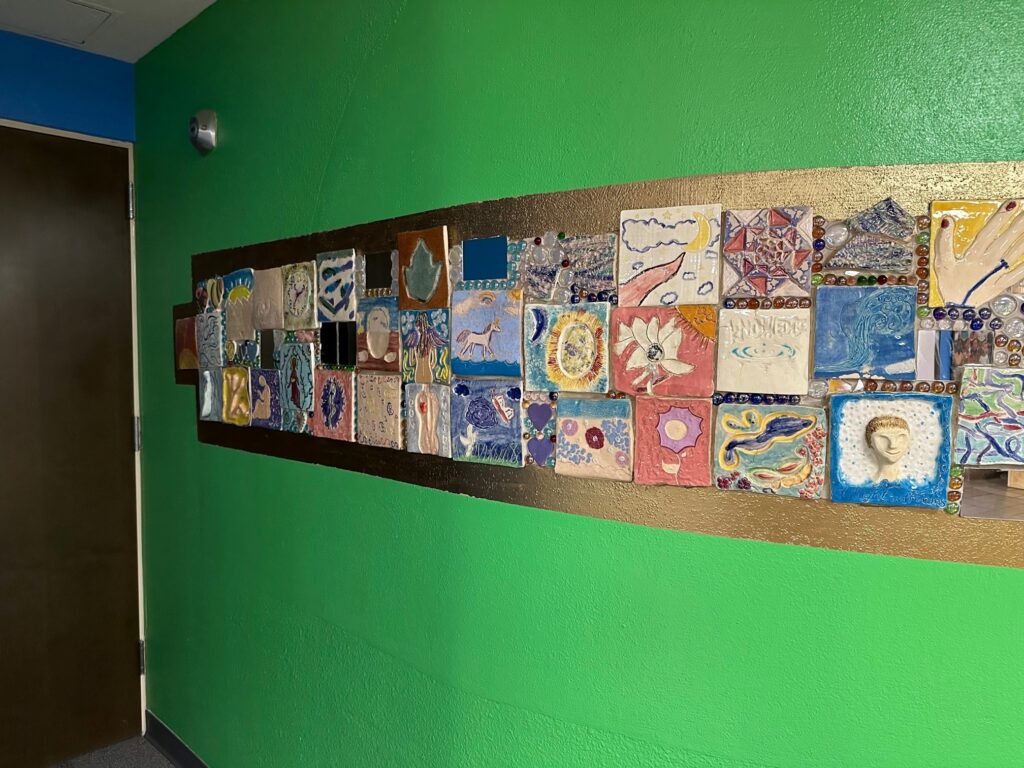
Let’s talk about the first one made by now middle-aged youth. It is a tiled mural located in the Children’s library titled “Tree of Knowledge/River of Wisdom” by Dorothy Zitzler, Rosemary Kirby, Oñate (now Organ Mountain) High School art students, and Court Youth Center (now Alma d’ Arte Charter School) after school program. The piece is a tiled mural, attached to a curved wall, installed in 2003. The library generously offered the space when approached by the class for wall space to complete their project.
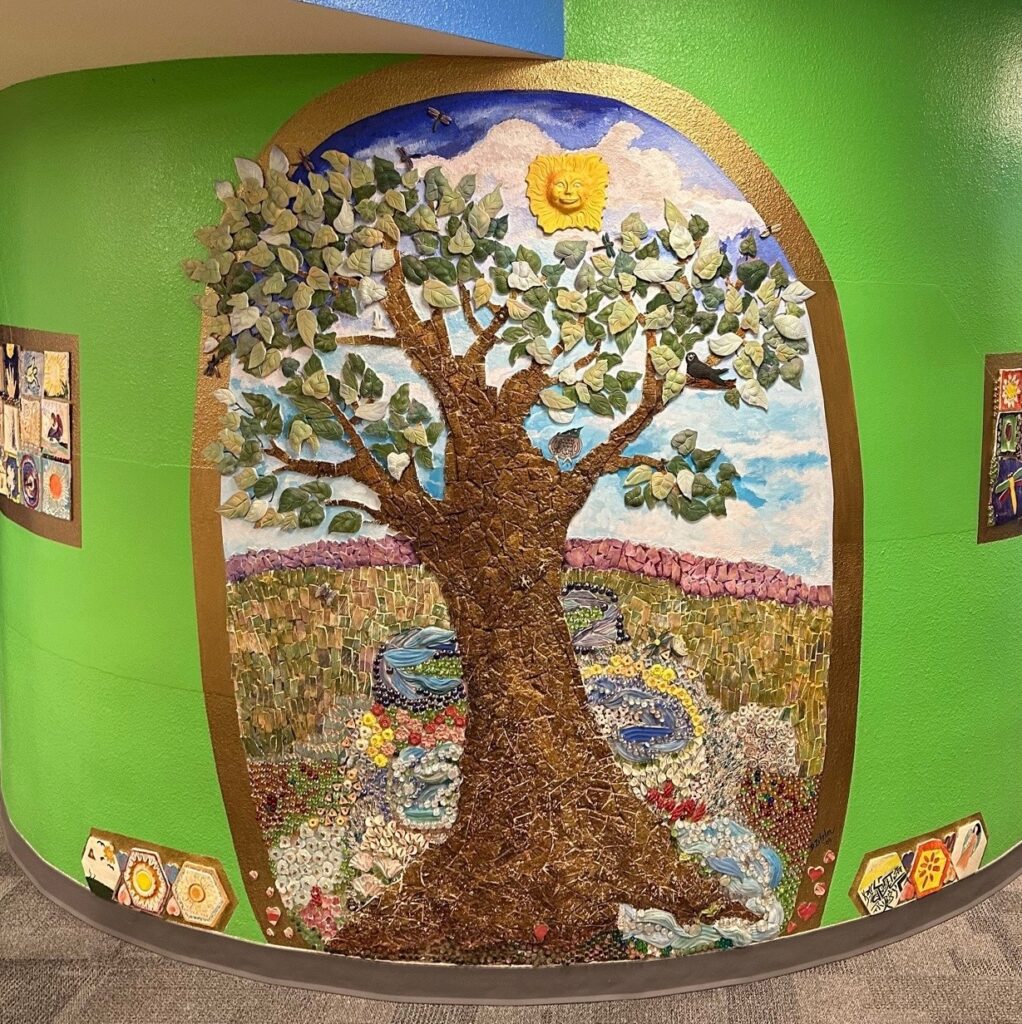
The bark of the tree is made of small tiles strategically placed to create the wood- like texture. The leaves are individually handcrafted to create a 3D effect. Birds and insects can be found hiding in the leaves. The river is made from glass stones and tiles to create the movement of water through a grass field. The student tiles are featured along the hallway in a gold painted banner. It’s very beautiful.
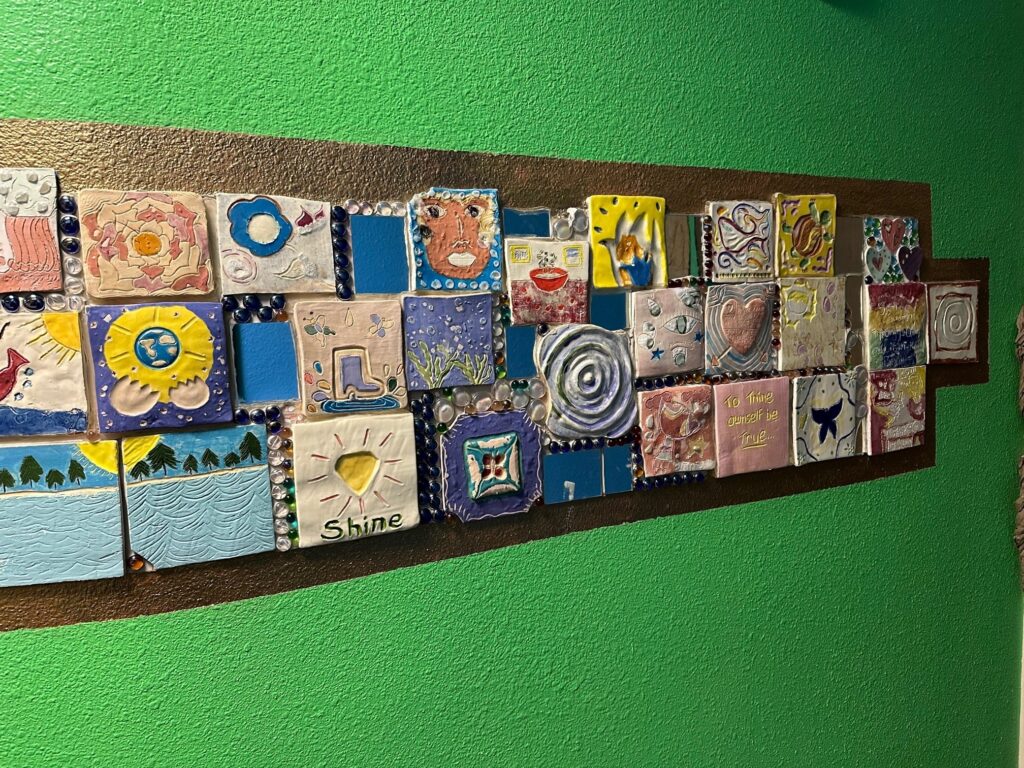
The children’s library is one of the areas of the Branigan Library that is going to be reconstructed as part of the renovation coming soon. When asked if the piece could be removed and reinstalled later, Dorothy Zitzler said she did not think the tiles could be removed successfully or kept intact to be able to recreate the mosaic on another wall.
The second piece is Refractor installed by Glenn Schwaiger in 1989 in the Thomas Branigan Memorial Public Library. It’s made of 768 mirrors and is attached to a wall facing the reference desk. The artist was awarded a grant from U.S. West Communications that funded the art project. “Refractor” was removed for repair of several broken mirrors in 1992 and reinstalled soon after. For the longest time, the art piece did not have a plaque, which was misplaced when the wall was painted or some such. Patrons of the library thought it was just a mirror on the wall. Glenn was not encouraging about being able to preserve this piece. After his experience reinstalling it after the previous repairs, he felt it might be damaged beyond repair in the process of removing it and didn’t think the effort would be worthwhile.
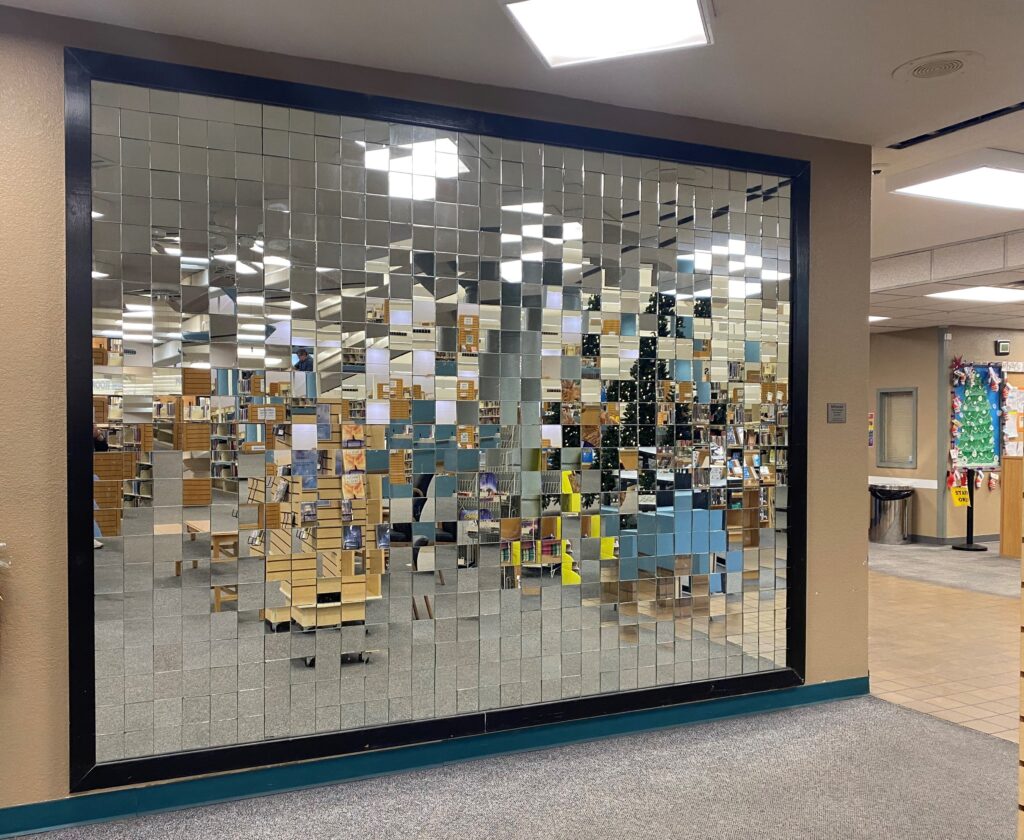
Both artists agree that some art works have a limited life span. Glenn feels that Refractor has had a good run. He sees it as an opportunity to commission new art for the library to celebrate the renovation. Dorothy feels the same; she does not think it is necessary to save the Tree of Knowledge/River of Wisdom. According to her, it has reached the end of its time, and it is ok to let it go, as hard as that is to do.
So, when the time comes, we will plan some sort of archival event to give everyone who has enjoyed them a sense of closure. And we will make every effort to salvage pieces from the student mosaic that can be offered to the artists who created them. But for now, when you visit the library, make time to appreciate the artwork while it is still there. Eventually, we will need to let it go.