
Not long ago, one of our public art selection committees held artist presentations for a commissioned public art piece for one of our parks. This is when artists present their proposals for a project and show us a small-scale model or maquette of the proposed new art piece for our community.
One of the selected artists presented a beautiful design made of an interlocked Corten steel shape designed to cast shadows as the sun moved across the sky that transformed the visual aesthetic of the artwork throughout the day. It also created a heart shaped frame for the Organ Mountains that sat in the distance. It was gorgeous and so perfect for the location. But…the design had one fatal flaw. The shape used by the artist was of the Zia Sun Symbol (Zia) and was therefore not considered further for the commission.
Wait, what’s wrong with that? The Zia is used in the New Mexico flag and is universally connected to all things New Mexico right? Wrong.
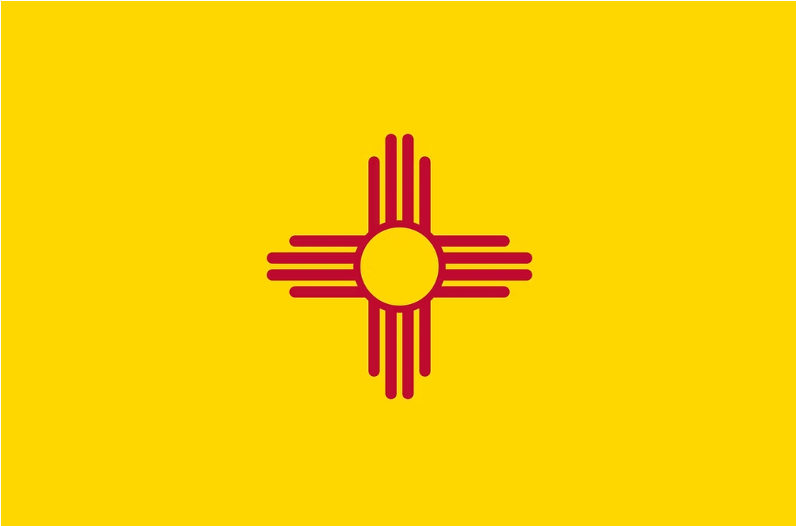
The history of the Zia, which is very sacred to the Zia Pueblo, is complex and contentious regarding its use and appropriation. As articulated by Noel Begay, Associate Public Art Project Coordinator, City of Albuquerque Public Art, the Zia was taken without proper consent to use on the NM flag. Being Diné, Native New Mexican, and an artist in her own right, Noel has the support of the Pueblo in advocating for a more accurate narrative of how the symbol was stolen.
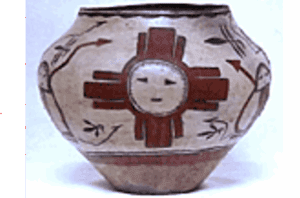
Here’s the story of how the Zia came to be on the NM flag as told by Noel: James Stevenson, an anthropologist working for the Smithsonian in the 1890s, stole pottery marked with an ancient symbol of a sun design, which was used in religious healing and wellness customs by the Zia Pueblo, from the Pueblo’s sacred ceremonial space (kiva). The piece was later displayed in a museum in Santa Fe. In 1924, Dr. Harry Mera, a distinguished Santa Fe physician and archeologist, applied for a Daughters of the American Revolution artist competition for the New Mexico State flag and won. His winning design featured a modernized version of the ancient Zia in Spanish Crown colors. The design was officially adopted as the New Mexico state flag in 1925.
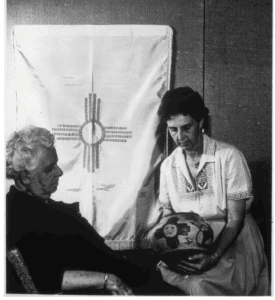
Noel stresses that the State of New Mexico has never acknowledged the theft of the Zia nor given reparations or recognition to the Zia Pueblo for its use. She advises anyone interested in using the Zia on merchandise establish a genuine relationship with the Zia Pueblo by donating a portion of profits from that merchandise to the Pueblo’s scholarship fund. There is also a form available on the Zia Pueblo website that can be submitted to get sanctioned approval from the Pueblo to use the symbol.
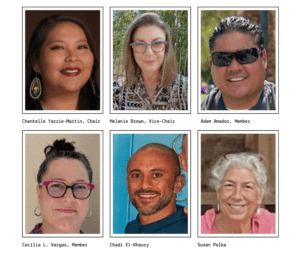
City Art Board Chair, Chantelle Yazzie-Martin, notes that the vetting process for the Zia tribe and Indigenous art or symbols is an important step to re-establish trust and respect given the tumultuous history with New Mexico and Indigenous peoples. Much of the experience of Indigenous peoples has been fighting for use of ceremonial items and symbology to be given back and reset to their own original definition. “For example in the Diné tribe, we have a symbol that in modern terms is initially recognized as a swastika and has been redefined as something extremely negative worldwide,” says Chantelle. “To the Diné or my people, it is a whirling log that is used in ceremonies for healing and represents well-being and protection. Bringing it back to the Zia tribe is an important step to reclaiming sovereignty and making sure our symbols are used in a good way as they were meant to be.”
The beautiful public art design using the Zia that I mentioned earlier was done by a non-Indigenous artist who resides in Arizona. It was slightly surprising that he was not more aware of the Zia as a sacred symbol, but even more curious was the fact that two of the selection committee members gave him top scores until they were informed by the rest of the committee that the design was not appropriate.
Noel advises artists to have some proof of having requested permission to use the symbol or some form of reparation for using it when submitting proposals to show good faith that they have considered the appropriation aspect of the sacred symbol.
Kudos to those in the committee for being informed and having the integrity to pass on what could have been an amazing art piece if it had been cleared by the Zia Pueblo. And those who gave his design top scores now know to be more aware of misappropriation of culture. Baby steps.